Before the Dial Tone Dies: An Analogue Audit for the January 2027 Switch-Off

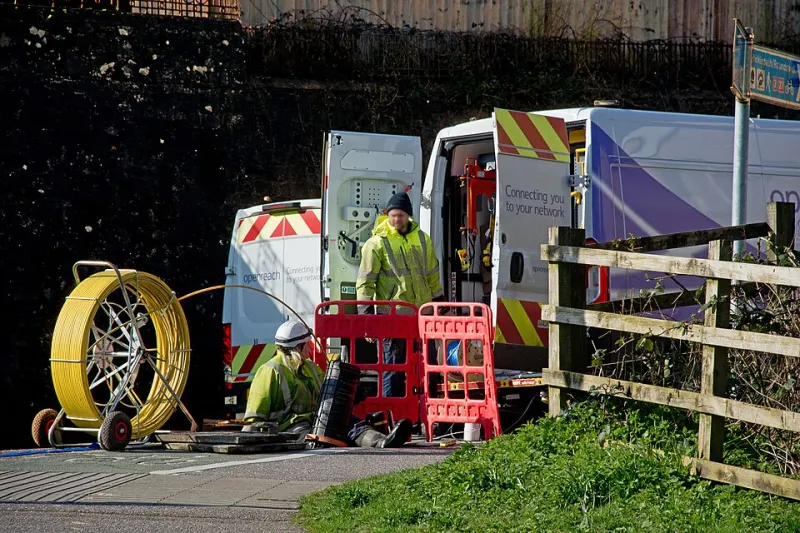
Photo: Hassocks5489, CC0, via Wikimedia Commons
The copper access network that has carried the UK's voice traffic for the better part of a century is being retired, and the date is no longer theoretical. Openreach closed PSTN and ISDN to new supply in September 2023, paused the wider withdrawal during 2024 to give the industry time to handle vulnerable customers properly, and has since confirmed that the remaining analogue services stop at the end of January 2027. For most households the change is invisible. For a home lab or a small office with a cupboard full of equipment that still expects a dial tone, it is a project with a deadline.
What actually changes on the day
The common misunderstanding is that broadband disappears with the voice service. It does not, in principle. What happens is that the voice channel is withdrawn and the broadband is re-provided on a single-order basis, which in practice means a new order, a new minimum term on many tariffs, and often a new router. A traditional line carried voice and data together; once the voice side is migrated, the data side has to stand on its own. Plan for a short outage on the migration day and for a contract conversation you would rather not have.
The second change is subtler and more important. An analogue line was powered from the exchange, so it kept working in a power cut. Digital voice runs over your router, which means it does not. Anything safety-adjacent that sits behind that voice service needs a battery-backed path or a mobile path, and that decision should be made deliberately rather than discovered during a storm in February.
Start with the cupboard, not the contract
Paperwork tells you what you pay for. A walk around the building tells you what you actually depend on. The usual suspects, roughly in order of how often they are forgotten:
- Intruder alarm panels with a PSTN signalling path, including older Redcare-style monitored lines.
- Telecare base units and pendant alarms, which are frequently installed by a third party and absent from any IT asset register.
- Lift emergency lines, which are a legal requirement and are almost never the IT team's responsibility until they fail.
- Door entry and intercom systems, particularly in converted buildings where the wiring predates the current occupier.
- Fax machines in clinical, legal and property settings, plus the analogue lines behind multifunction printers.
- Card terminals and EPOS kit that still dial out for authorisation or overnight settlement.
- A legacy PSTN router kept for out-of-band management, or a modem attached to a building management system.
- Set-top boxes, legacy telemetry and any device with an RJ11 port that nobody has touched since installation.
Each one needs an owner, a supplier, a contract position and a migration route. If nobody can name the owner, that is the finding.
Test procedures that produce evidence
Do not accept a verbal assurance that a line is working. Produce a record.
Start with a butt set or a plain analogue handset on every line you have found. Listen for dial tone quality, note any hum or crackle, and dial a known number. Where you have access, measure the on-hook voltage, which should sit in the region of 48 volts DC, and check loop current on a seized line. Readings at the margins tell you the pair is already fragile and may fail before the deadline rather than on it.
For monitored alarms, place a test call to the alarm receiving centre and ask for written confirmation that the signal arrived with the correct account and zone information. A panel that logs a weekly line fault has been telling you something for months. For telecare, test the pendant and the base unit separately, confirm the monitoring centre answers, and check that key-safe details and responder contacts are current.
Establish whether each device already has an IP or cellular path available, and whether it can run dual-path. Single-path IP signalling is a step sideways, not forward. Then ask the question that catches most sites out: what happens during a power cut, and how long will the optical network terminal and router survive on battery?
Record everything in one register: line number, equipment, location, supplier, contract end date, migration route, responsible person, date tested, result. A spreadsheet is sufficient. A shared spreadsheet is better.
Questions to put to your provider
- Will my broadband be re-provisioned to a single-order product, and does that start a new minimum term?
- Is the replacement voice service delivered from the router, from a separate adapter, or from a dedicated device?
- What is the behaviour on power loss, and is battery backup included or chargeable?
- Does the replacement service support alarm signalling, or must I move to IP or cellular at my own cost?
- How are number porting, 999 and 112 access handled, and what registration process applies to the service address?
- What are realistic lead times, and can engineering visits be scheduled outside business hours?
- What happens to static IP addressing, port forwarding and any line-specific configuration?
- If the migration fails on the day, what is the escalation path and the expected restoration time?
Fallbacks worth paying for
A dual-WAN router with a cellular modem on a different network from your primary ISP is the single most useful purchase. Pair it with a small uninterruptible supply covering the optical terminal and the router, sized for at least an hour, and test the failover quarterly rather than trusting the configuration. Keep one charged mobile handset on the premises, on a different network again if possible. Print the runbook, including the numbers people will need when the network is down, because a runbook stored in a wiki is not a runbook.
A 60/30/7 timeline
Sixty days out, finish the register, order replacements, book engineering and start the contract conversations. Thirty days out, migrate voice, place alarm test calls, and confirm emergency access registration. Seven days out, re-test everything, print the runbook and brief anyone who will answer a phone. The day after migration, check logs, confirm billing and close the register entries one by one. The deadline is fixed; the work is entirely schedulable.